My Grandfather, Appa
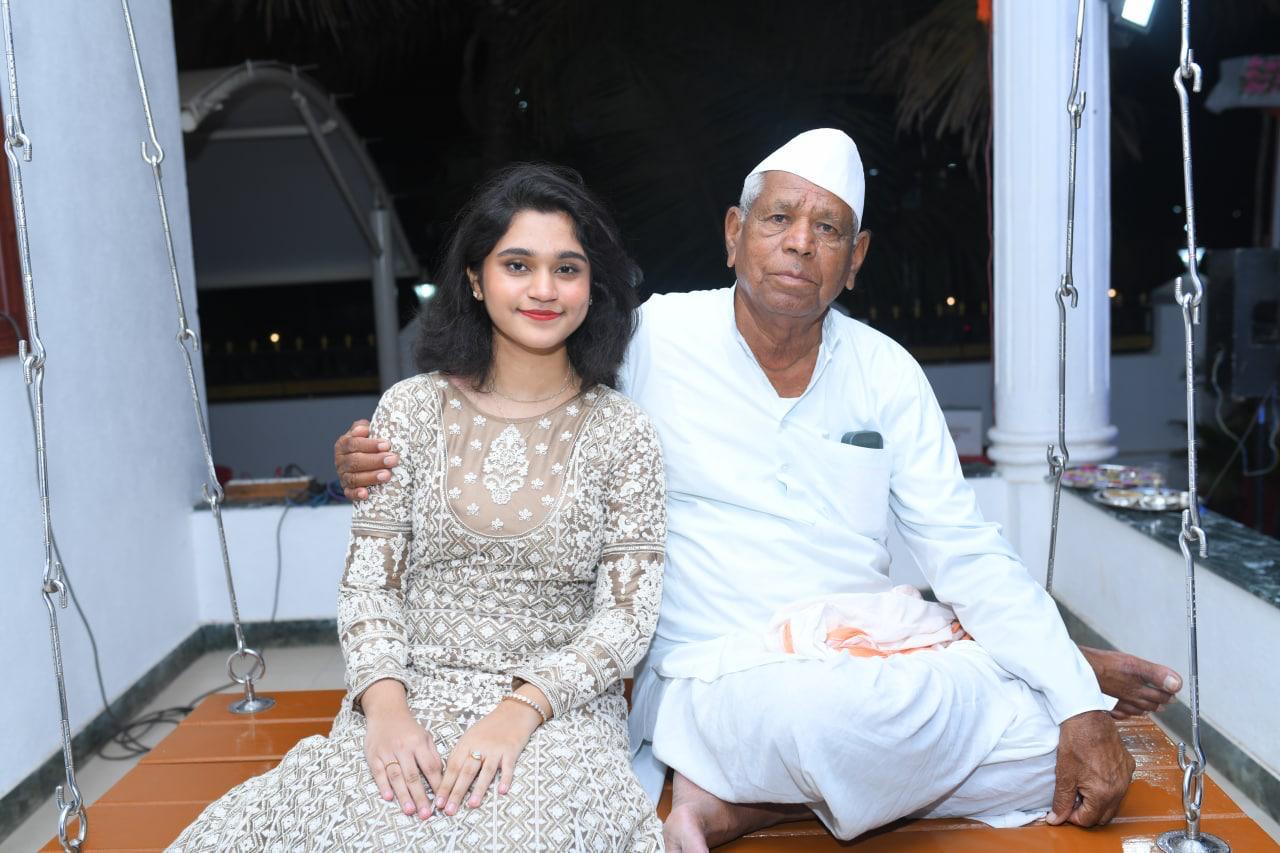
What does it really mean to be close to someone? Is it about spending time together, having long conversations, or simply sharing memories? In this article, Mrunmayi Khedkar writes about her relationship with her grandfather and the small moments that brought them closer. Appa was a village leader, a peacemaker, a family man and a mentor to many people. Through her memories of him, Mrunmayi reflects on love, grief, regret and the distance that can sometimes exist between generations. More than a story about losing a grandfather, this is a reflection on how we understand the people we love, sometimes only after they are gone.
We all called him Appa. By the time I entered the world, Appa was already sixty eight years old. He had lived almost an entire lifetime before mine had even begun. Born on 8 September 1937, he had been a village head for about fourteen years, raised a family so large that gatherings felt more like festivals, survived losses, witnessed generations grow, and built a life that eventually drew hundreds of people to his funeral.
He passed away unexpectedly on 18 August 2025 at the age of eighty eight. I was simply the youngest daughter of his youngest son, arriving after most of his story had already been written. Naturally, I received the smallest fraction of his time. Perhaps that is why I always wanted more.
Our relationship, in many ways, began with disappointment. When I was born, there was an expectation that the family's beloved son would have a son of his own. Instead, I arrived - a girl. I have been told there was gender disappointment. It is strange to think that the first chapter of our relationship started with expectations I had no control over. But the beautiful thing about love is that it can outgrow expectations. As the years passed, that disappointment quietly disappeared. What remained was simply Appa and me.
Appa wasn't educated in the way the world measures education. On paper, he was considered illiterate. Yet he was one of the wisest people I have ever known. Ironically, despite never receiving a formal education himself, he valued it immensely. Every visit ended with the same advice: "Study hard, just like your father." It was his quiet way of telling us that he wanted our lives to be bigger than his had been.
To everyone who knew him, Appa was far more than my grandfather. He was a respected village head, an exceptional peacemaker whom people trusted to resolve disputes, a devoted family man, a remarkable social worker, a matchmaker who brought families together, and a mentor who helped shape the political journeys of his daughter, daughter-in-law, and nephew. In his younger days, he was also an imposing figure: tall, broad shouldered, and disciplined enough to exercise regularly, carrying a strength that reflected both his physique and his character.
The truth is, I spent much of my childhood wanting to be closer to him. "I am not very close to my grandfather." It was an easy sentence to believe. After all, closeness is supposed to look a certain way. It is supposed to mean endless conversations, shared routines, and memories that spill effortlessly into one another. When I compared myself with my second cousins who lived with him, I felt I had none of that. They didn't need occasions to know him. I did.
For a long time, I thought that meant I wasn't close to him. Now, after losing him, I realise that wasn't the whole truth. I carried an odd kind of fear of missing out. On my own grandfather. Yet whenever we finally met, something funny happened. We had almost nothing to talk about. There was no dramatic reason. We simply came from different centuries. There was a language barrier that had nothing to do with words. And yet, somehow, we still managed to understand each other.
Our relationship never depended on long conversations. It survived on tiny rituals. He couldn't pronounce my name properly because it was too difficult, so he simply called me whatever version made him smile. He loved reading the lines on our palms, confidently predicting futures that none of us ever questioned.
He used to look at me proudly and tell me I had the physique of a wrestler, quite similar to his. He wanted me to exercise, become stronger, and be the best version of myself. Looking back, it makes me smile. I would proudly show him my newly dyed red, purple, or pink hair. He would stare at it with complete disbelief before saying something along the lines of, "Oh my God! kids these days." That was our conversation. And somehow, it was enough.
In his later years, Appa spent most of his days in the stables. Surrounded by horses, cattle, and silence. Looking back, I wonder whether animals became easier companions than people after he had outlived all three of his brothers. Losing an entire generation must leave behind a loneliness that young people cannot fully understand. Maybe the stable wasn't just where he kept the animals. Maybe it was where he kept his peace.
The last time I saw him remains frozen in my memory. He was sitting there in the stables exactly as everyone said he would be. The moment we arrived, he began to cry. I didn't understand then why that image stayed with me for so long. Now I think I do. Sometimes people don't cry because they are sad. Sometimes they cry because seeing someone they love is enough. Not long after that came what has become my greatest regret. I had a chance to visit him, but I didn't go. College deadlines felt important. I told myself I would just visit him next time. There wasn't a next time. For a long time, I carried guilt over that decision. I kept wondering what more I could have known about him. What stories I never asked him to tell. What questions I forgot to ask. How many pieces of his extraordinary eighty eight years disappeared with him.
Then I started asking myself a different question. Can one missed visit erase years of love? I don't think it can. As his first death anniversary approaches, writing this somehow feels inevitable. Out of everything I could have written about, I chose him. Maybe this essay is less about remembering Appa and more about understanding him for the first time. His funeral answered a question I never knew I had. Hundreds of people came. People travelled simply to say goodbye. That crowd wasn't there because he had been wealthy or famous. They came because of the life he had lived and the kindness he had left behind. If success is measured by the number of lives you quietly improve, Appa was one of the richest men I have ever known.
Today I can finally admit something to myself. Our relationship never became what it could have been. It only scratched the surface of the conversations we might have shared if life had given us more time, fewer kilometres between us, and perhaps fewer decades separating our worlds. But I have also realised something equally important. It did not need to become more to matter. Love is not always measured by the number of words spoken or the number of years spent together. Sometimes it lives in a grandfather who cannot pronounce your name but never forgets your face. Sometimes it is letting him read your palm even though neither of you believes the future can truly be predicted.
Appa was my first experience of losing a grandparent, my first experience of watching death come close enough to touch my own family. Grief has a strange way of introducing adulthood. I think many people in my generation share relationships like ours without realising their depth until it is too late. We mistake silence for distance and ordinary moments for insignificant ones.
If Appa taught me anything, it is this:- Cherish more. Love more. Ask more questions. And visit when you can.
Because not every relationship gets to become everything it could have been. But that does not make it any less real. I spent years believing I wasn't close to my grandfather. Now I know a better way to describe us. We weren't close in the obvious ways. We were connected in the quiet ones.
And sometimes, those are the relationships that stay with you the longest.
