Parameters of Gender in Digital Age
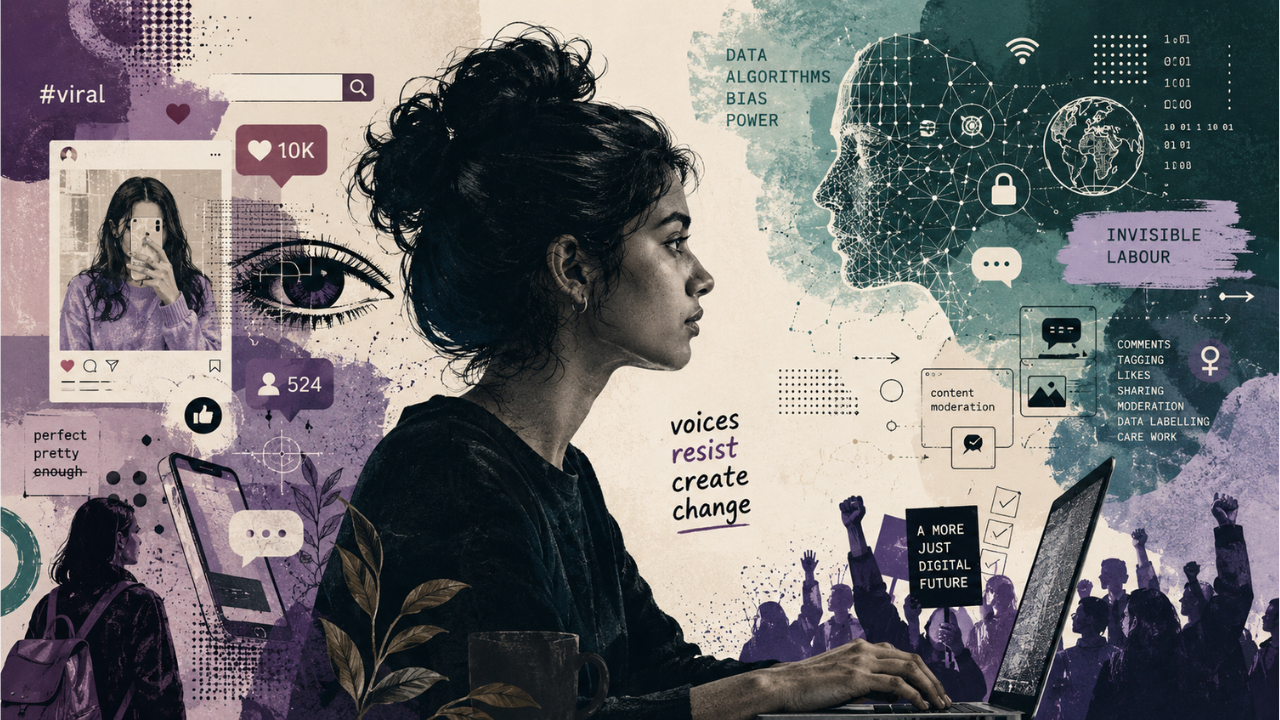
The digital revolution has transformed the way we communicate, learn, work, and understand ourselves. In this thought-provoking essay, Saee Pawar, a researcher, writer, and translator, examines the intersection of gender and the digital age, exploring how technology simultaneously reinforces patriarchal structures and creates new possibilities for feminist resistance, community, and self-expression. Drawing on contemporary research, social theory, and real-world examples including social media, platform capitalism, artificial intelligence, and invisible digital labour, she invites readers to critically examine who benefits from technological progress and what a more just digital future might look like.
Today, our lives are heavily intermediated by digital technologies, forcing us to refer to this time period as the digital age. But, what exactly is the digital age? In simple terms, the digital age is the time period where almost every aspect of life is intermediated or impacted by global communication networks or the internet. It is our everyday use of smartphones, computers, and instinctively reaching for an online search engine for any questions that pop up in our heads.
Digital age is also called the information age. It is fundamentally based on complete access to information and hyper-connectivity. Both of these things have a deep impact on how we view and interact with the world. Digital or information technology is a tool like any other. It is used by different people with differing ideas and biases about the world. And so the digital space gets colored in different shades. This is not a new thing. Though what is new and interesting is the worldwide common space for interaction and exchange of ideas that the digital age has provided. People from almost every part of the world are occupying this infinite space, with speedy flows of information and with each other. And so we get to see different and opposing lines of thought and beliefs interact, become allies, compete with the opposite etc. This is the same old story of opposing forces clashing, only in a newer and faster space. There is no changing the story. What we can do is recognize the patterns of these interactions and be mindful of our actions in relation to these patterns.
Gender and Digital
What are the patterns around gender? How are women and queer people placed in the digital space? In a world where the boundaries between online and real lives have blurred, how have the questions around gender expression and gender equality changed? Many such questions turn up as we look at the intersection of gender and the digital. In this interaction the first thing to get noticed is the adaptation of digital technology by old beliefs and hierarchical structures. The Internet gives you caste specific matrimonial websites, objectification and harassment of women on social media, trends like tradewife that coax young women to embrace exploitative patriarchal practices etc. On the other hand, information available online has forced an awareness of deep rooted gender inequality and pushed many towards a more liberal and feminist perspective. It has allowed people to see the interconnectedness of different fields. For instance, the overlap of climate action and gender justice. What was confined to ecofeminism, now has found a much larger audience on the digital space as people slowly recognize the same structures of patriarchy and capitalism that exploit women and also destroy the diverse ecologies on the planet. In a similar way, slowly and gradually, an allyship is forming between anti-racism movement, LGBTQIA+ movement, anti-caste movement, feminist movement etc. Although this picture behind this allyship is not all rosy, the simple scale and reach of perspectives that combine fight for justice in different spheres is hopeful.
In short, a lack of credible historical narrative coupled with curated reality presented in the online world, disorients people on a scale that is difficult to even measure. And so, a tug of war ensues between these patriarchal structures and feminist forces. This is a war to control narrative or people’s minds and opinions, and it unfolds through choices made by people in their everyday lives.
Social Media Paradox
First and most noticeable space of this conflict is the paradox of self-expression on social media. Image and visual focused media changes dimension and language of self-expression drastically. It creates an interesting context for people to present themselves. Frequently trending dance reels, expansion of selfie discourse to fully alter one’s online personality, and the boom of influencer culture are few examples of it. When we look at gendered self-expression, the picture gets more complicated. Hyper visibility of social media accompanied with constant scrutiny adds to the already contorted space of self-expression of women, simultaneously making their body into a commodity.
The selfie trend and the discourse around it has been hailed as women’s acceptable entry into the public sphere. (Burns, 2015) However, stereotypical gender displays on social media continue to dominate mainstream. Through presentation of self in online space, a new dimension gets added to the term ‘public’. Women’s presence in this public sphere is controlled by restricting their access to technology. We all know restrictions placed especially on young girls and boys limiting their phone use to a few hours a day. In an interesting interaction with a few teenage girls in rural Maharashtra during a fieldwork I found out that mobile phone use also had a curfew. None of them were allowed to use mobile phones after 7 in the evening, echoing the restriction on women’s mobility at night. Many young girls as they grow up, fight for more time and autonomy on social media and other online spaces. The quest for this kind of autonomy is an attempt to have more control over one’s self image and expression while not fully facing the inconvenience of breaking social norms in everyday life. However, women being in a hyper-visible public sphere also generates a great deal of judgement. This creates a peculiar harshness for women simply existing in online spaces. Trends in popular culture reflect the tug of war between conservative and progressive chains of thought. You will see heartfelt messaging about equality, mental health, climate etc.
You will also see content that spews hatred towards a particular community, promotion of regressive values through trendy fashions, normalized violence etc. Similarly, you will see women’s empowerment portrayed in different ways online. Content and advertisements including confident women or independent women with regional and racial diversity are a common thing in online spaces. At the same time, essentializing femininity to motherhood, new presentations of traditional gender roles and objectification of women’s bodies is rampant. In an interesting case of overlap between two opposing factions, postfeminist discourse also tries to reclaim bodily autonomy in objectification by claiming sexual autonomy/freedom as empowerment. (Gill, 2007) In online spaces empowerment and consumerism get heavily intertwined. Digital spaces, much like capitalism, utilize women’s empowerment and feminist discourse to advance its own consumerist agenda which aims to keep people engaged as much as possible.
While there are limits to online activity, the seemingly limitless freedom allows people to express themselves and their gender identities fully and confidently. Online connections and community spaces become support networks for many sexually, socially and mentally suppressed individuals. Finding and connecting with people who struggle with the same things as you do creates a deep sense of belonging and community. This feeling of belonging spans from fan groups to artists groups to mental health support groups. Sites like reddit or twitch allow people to form groups based on their niche interests. This seemingly limitless freedom also allows people from remote or rural areas to connect with the world, or individuals with little physical freedom to get a space of their own to express themselves.
In remote tribal areas of Maharashtra to corners of Himalayan mountains in Himachal Pradesh, whenever I have asked teenagers or young people about their phone use, they have proudly shared location on that one exact spot with internet connectivity in an otherwise disconnected region. They walk for hours, climb multiple mountains to reach that spot and spend a few hours there enjoying the online world. Some watch videos, some play games, some create their own content. Before the Tiktok app was banned in India, it housed many content creators that came from rural, working class backgrounds. Even today young people from remote rural areas share their lives, their histories, their art on available social platforms. In this sharing presence of young girls is prominent. However, this self-expression and freedom in the digital domain does not necessarily lead to deep and long-lasting changes in gender ideologies or class positions. This is because mediated self-representations are linked to markets and profit systems that characterize social media platform’s logic. (Kanai & Dobson, 2016)
Towards Utopia
In order to understand the logic and politics behind the digital space, we first need to understand what makes the digital world tick, what are the norms and how do they seep into the real world, and finally how are things changing there. Let’s take an example of the boom of STEM careers in the early 2000s. The obsession with the disciplines of science, technology, engineering, mathematics or STEM has had a far-fetched impact on the education system in India. Having its basis in the dream of a science led digital future, the STEM obsession eventually led us to a world populated by efficiency focused and ethically blind people. There are comparatively fewer women in STEM fields, and the ones who are there speak about rampant misogyny in the workplace. The presence of patriarchy in high-tech fields, led to many women questioning the system after a few years. Financial opportunities afforded by STEM careers did create social acceptance for women’s higher education and participation in the workforce. However this acceptance was always conditional. The underlying expectation here is that a woman will use her financial freedom to support her family or children or men in her life. It has also been a safer choice that does not raise many questions on existing social structures. STEM in the early 2000s was considered a clear way forward towards a brighter future, a science led utopia for everyone. Yet as the successor of STEM, in terms of the future bearer, that we see in the 2020s is artificial intelligence or AI, which has even more concerning factors.
AI is the buzzword of this age. Said to increase efficiency and help humans work smarter and faster, AI is spreading in all domains of life. AI performs mundane and repetitive tasks that historically were performed by women as part of care work. Unsurprisingly, many designs of AI have imagined it as a woman. Siri, one of the most popular interactive AI has voice of a woman. Far from being gender-neutral, the digital world reproduces and reconfigures existing gendered divisions of labour, representation, and power. Kylie Jarrett's concept of the "digital housewife" argues that much like domestic labour, digital labour is simultaneously socially and economically valuable yet largely invisible, undervalued, and often uncompensated (Jarrett, 2015). Everyday activities such as creating content, generating data through online interactions, moderating content, and performing emotional and communicative work produce immense value for digital platforms while appearing as voluntary participation or leisure.
This framework helps explain the feminisation of much AI-related work, where women are disproportionately engaged in repetitive, affective, and cognitive tasks such as data annotation, content moderation, and voice training that are essential to artificial intelligence but remain poorly paid and unrecognised (Jarrett, 2015; Gray & Suri, 2019). For instance, a saree clad robot was used in a Delhi hotel to greet AI summit guests in February 2026 (Hindustan Times, 19 February 2026). Last year, the viral AI-generated "vintage saree" trend on social media, powered by generative AI tools such as Google's Gemini, has further demonstrated how femininity, beauty, and tradition are mobilized through AI-generated imagery. This also raised concerns around consent, privacy, deepfakes, and the reuse of personal images for AI training. A woman having used AI to generate a vintage saree image was shocked to see a mole on her left hand in her saree image that was never visible in the reference photo she shared. “So a trend is going viral on Instagram where you upload your image on Gemini with a prompt and Gemini converts it into saree… I tried it last night and I found something very creepy about it. How does Gemini know I have a mole in this part of my body?” (The Indian Express, 18 September 2025). Similarly, the new AI glasses with cameras have made privacy a thing of the past.
While there is a large-scale critique of AI, many excuse it for its functionality. AI does the time intense, mundane tasks for you. It saves time and effort, freeing us to pursue other more important things. Keeping aside the gaping holes in this fantasy, what is hidden behind the AI fairytale is women’s labour. The recent three-part series by BehanBox on AI Labour, written by Saumya Kalia, argues that the AI revolution is fundamentally dependent on a vast, largely invisible workforce performing low-paid, precarious, and often emotionally demanding labour. Most of these workers are women. Busting the myth of AI as an autonomous or immaterial phenomenon, recent literature is revealing the human labour that powers every stage of AI development. From data collection and annotation to content moderation, transcription, voice work, and quality control a largely feminized labour force is behind it. A recent documentary named ‘Humans in the Loop’ directed by Aranya Sahay offers a deeply personal perspective towards the invisible workforce behind artificial intelligence. It demonstrates that the digital economy is not only shaped by algorithms but also by deeply gendered and racialized labour relations, where care, communication, emotional resilience, and repetitive cognitive work (skills often associated with women) are systematically undervalued even as they become indispensable to technological innovation.
Making Sense
A lot of recent research and literature demonstrate that gender shapes digital technologies at every stage; from the invisible labour that builds AI systems to the cultural narratives through which AI is represented, revealing how platform capitalism continues to rely on and normalize gendered forms of labour, care, and representation.
There is a constant theorizing happening all over the world to make sense of the digital age, not only from a gendered perspective but also from an existential one. Byung Chul-Han, borrowing from thinkers like Walter Benjamin, criticizes the digital age for the grand shift from narration to information. In his book ‘The Crisis of Narration’, he talks about how reality itself is now taking the form of information and the ways in which omnipresence of all information at all times adversely affects our quality of life. As human beings our memory is selective, and it gets constructed again and again. Information on the digital platforms on the other hand is not selective but is rather overwhelming. This puts people into a crisis where they struggle to keep up with the magnitude of information everyday. What is essentially being described here is the heaviness we feel when we see the news of what is happening all over the world, the fatigue of being constantly connected online and isolated in real life, the burnouts happening from the fast pace of life etc.
Byung Chul-Han says, ‘late modernity lacks narrative imagination’ (Han, 2024 p. 28), which leads to disenchantment of the world. While this critique of the digital age is more than valid, looking at this crisis of narration from a gendered perspective shows us another layer of complexity. Byung Chul-Han rightly points out, the world is being disenchanted through the cold, flat information replacing the myths and stories. This leads to disorientation for many people but it also leads to something else. What happens when every aspect of life is laid bare through gapless information is the invisible labour and oppression of women and other minorities also becomes visible. It is not a coincidence that the younger generations, the ones that grew up with the internet, are more socially aware. The cold, hard data made it possible for the invisible labour to be accounted for and made it impossible for any honest person to overlook it. It was easy for people to connect colonialism, fascism, patriarchy and capitalism. Oppression of women, colored people, indigenous people, workers that built and maintained the society busted the myth. The care work, the mundane work of maintaining every small thing was what went behind the enchantment of earlier times. The narrative which we miss today, was patriarchal. Knowing this has made way for feminism, moral clarity and call for justice for many. And so as we stumble into the new age of information we must look for a balance, for a way to keep moving without losing ourselves.
References Burns, A. (2015) Selfies| Self(ie)-discipline: Social regulation as enacted through the discussion of photographic practice. International Journal of Communications. https://ouci.dntb.gov.ua/en/works/42j012W4/
Gray M. and Suri, S. (2019). Ghost Work: How to Stop Silicon Valley from Building a New Global Underclass. Houghton Mifflin Harcourt, Boston & New York. https://www.its.caltech.edu/~haugen/Ghost-Work-reading.pdf
Gill, R. (2007). Postfeminist Media Culture. Sage Publications. https://journals.sagepub.com/doi/10.1177/1367549407075898
Hindustan Times, Jain S. Feb 19, 2026. Saree-wearing robot greets AI summit guests at Delhi’s 5-star Shangri-La Eros. https://www.hindustantimes.com/trending/sareewearing-robot-greets-ai-summit-guests-at-delhi-s-5-star-shangri-la-eros-101771474821875.html
Kalia, S. (2025–2026). AI and labour series. BehanBox. https://behanbox.com/2026/02/09/indias-ai-boom-runs-on-womens-unpaid-care-and-cognitive-labour/
Indian Express, September 18 2025. https://indianexpress.com/article/trending/trending-in-india/google-gemini-ai-nano-banana-saree-feature-instagram-viral-privacy-concerns-10253225/
Han, B.-C. (2024). The Crisis of Narration (D. Steuer, Trans.). Polity Press. Jarret, K. Feminism, Labour and Digital Media: The digital housewife. (2015) https://www.routledge.com/Feminism-Labour-and-Digital-Media-The-Digital-Housewife/Jarrett/p/book/9781138575660
Kanai, A. and Dobson, A. (2016). Digital Media and Gender. In The Wiley Blackwell Encyclopedia of Gender and Sexuality Studies (eds A. Wong, M. Wickramasinghe, r. hoogland and N.A. https://onlinelibrary.wiley.com/doi/abs/10.1002/9781118663219.wbegss653
