Privilege and Reservation: A Personal Dilemma
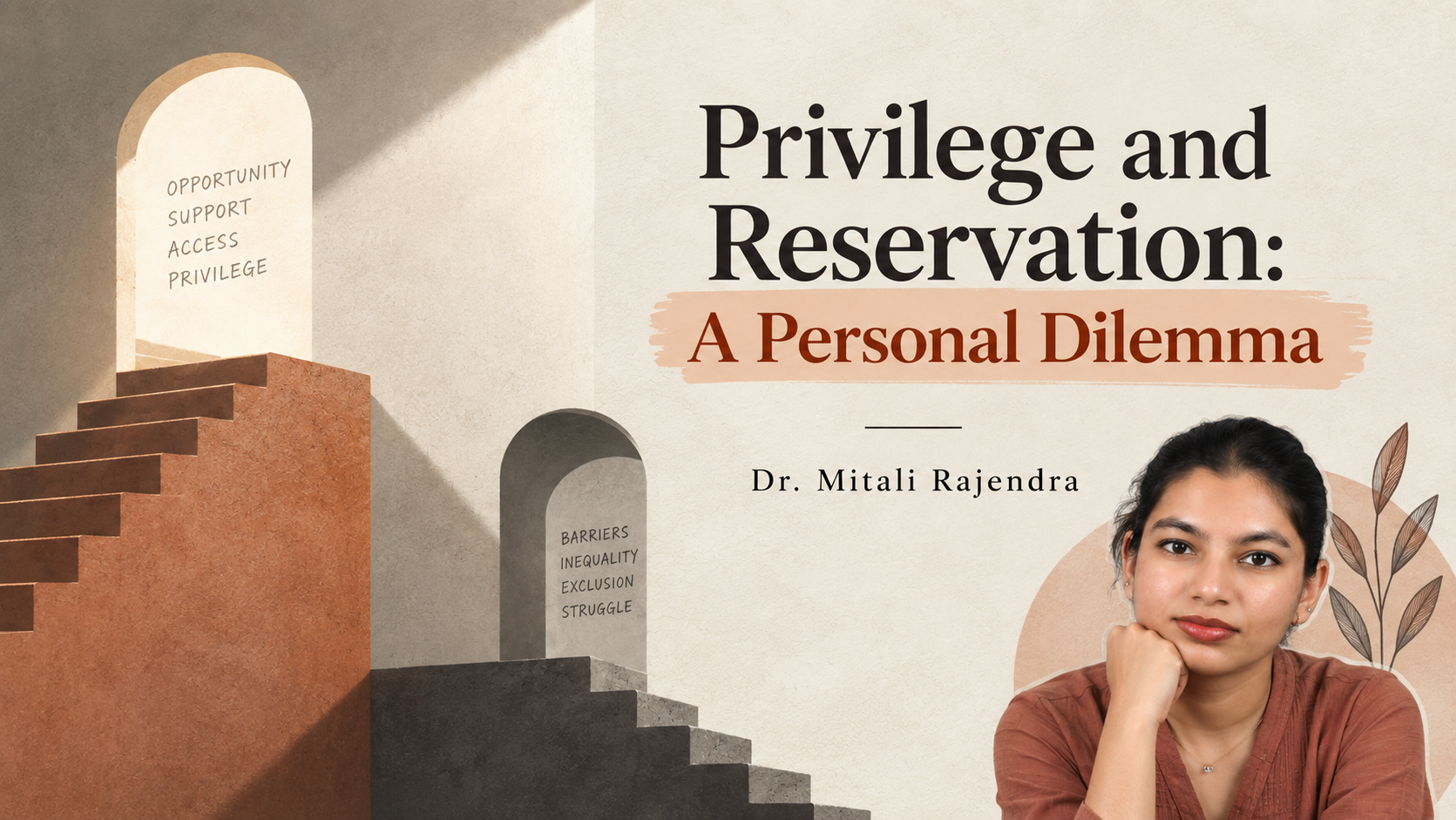
The debate around reservation is rarely as simple as merit versus equality. Questions of caste, privilege, economic security and historical exclusion often overlap in ways that are difficult to capture in social media arguments or political binaries. Dr. Mitali Rajendra brings a deeply personal perspective to this conversation, shaped by belonging to a historically marginalised community while also growing up with considerable economic privilege. Her questions challenge us to look beyond whether reservation is “fair” and instead ask what fairness can really mean in a society where caste continues to shape opportunity, dignity and access.
Ever since the protests surrounding the NEET-UG examination, the reservation debate has once again taken over social media. Instagram comment sections turn into battle fields, my feed is flooded with posts about merit and fairness, and suddenly everyone seems convinced that they have found the answer to equality. People debate who deserves a seat, who has an unfair advantage, and whether reservation should still exist. One question keeps resurfacing, “Is reservation fair?”
But I keep wondering — is that really the most relevant question to ask in 2026?
Shouldn’t we first ask why west ill live in a society where caste and religion continue to shape people’s lives? Why does subtle caste discrimination continue to exist in so many places, even while people insist that it no longer does?
Somewhere along the way, we begin to believe that every issue must fit neatly into one of two boxes—left or right, for or against. Reservation has become one such issue, where everyone expects you to choose a side. I can’t. Because my own life refuses to fit neatly into either box.
I was born into a historically marginalized community. At the same time, I grew up with privileges that many people never get to experience. My parents worked tirelessly to build the life we have today. We never had to worry about having enough food, paying school fees, or whether we could dare to dream big. By almost every measure of class and economic status, I have lived a privileged life.
This very privilege is often used against people like me—those who come from historically marginalized communities but have achieved economic stability. It is as though financial security somehow erases the history that our communities have endured, or continue to endure. Sometimes, society seems uncomfortable accepting that someone from a so-called “backward” caste can build a comfortable and successful life.
People are often surprised when they learn my caste. I’ve heard people say, “You don’t look like someone from that caste.” I never know how to respond. What exactly is a caste supposed to look like?
Ironically, many of the same people who claim that caste no longer matters still carry deeply ingrained stereotypes about how people from different castes should look, speak, behave, or live. That, in itself, is proof that caste has not disappeared as much as we would like to believe.
Growing up, I was also confused about where I stood in the reservation debate. My father is a gazette officer. Hence, I fall under the creamy layer criteria applicable to my category. I have therefore never been eligible for reservation benefits and have always competed in the open category.
For a long time, I wrestled with an internal conflict. When my friends complained that reservation was unfair, I understood where they were coming from. In many ways, I still do. Competition is brutal. Seats are limited. Rejection hurts. I have felt it too.
But as I grew older, I gradually came to terms with that conflict—not because I found all the answers, but because I stopped looking for simple ones. Whenever I feel wronged I ask myself these questions: Should I see myself as a victim?
Should I feel guilty for the privileges my parents worked so hard to provide? Should I avoid making the most of those privileges to build the best life I can? And if I dream of a society where caste no longer determines anyone’s future, why should I participate in conversations about caste at all?
Reservation was never meant to eliminate in equality overnight and it exists because in equality still exists. When we reduce this debate to income alone, I believe we forget one of the fundamental reasons reservation was introduced. Its purpose was never simply to educate every Indian. It was meant to address centuries of structural exclusion, reduce discrimination, and improve representation and inclusion in spaces where certain communities had historically been denied access.
The fact that my family has achieved financial stability does not erase my community’s history. Nor does it mean that everyone from my community has had the same opportunities that I did. My story is only one story.
I am also aware that me not getting into the country’s most prestigious university wouldn’t have bought my life to a halt. My family supported me in pursuing education elsewhere. We could pay the fees and even take an educational loan. Many families simply do not have those options.
For some students, the question is not whether they will get into their dream college. The question is whether they will be able to pursue higher education at all. Even today, many girls are married before they complete their education. Some children cannot afford text books. Others work in farms, factories, or as daily wage labourers because their families cannot afford to lose even a single day’s income.
For them, education is not merely a matter of ambition. It is a matter of survival—and often the only way to break a cycle that has continued for generations. That is why I believe we are arguing about the wrong thing.
Instead of confronting the discrimination that made reservation necessary, we spend more time arguing about reservation itself. We question the policy, but rarely question a society that judges people by their surnames, discriminates in housing and employment, or forces people to hide their identities.
The day caste truly stops influencing a person’s opportunities, dignity, and safety, we should seriously ask whether reservation has fulfilled its purpose. Until then, it often feels as though we are debating the solution while pretending that the problem has already disappeared.
Despite being aware of my own privilege, all I really want is to pursue my own aspirations while treating people with humanity, and to help those who need support, regardless of their background. I do not want my privilege to make me ignorant. Instead, I want it to make me more aware, more conscious, more compassionate, and more responsible as a citizen.
If I have received opportunities that others did not, I hope to use them not only for my own progress but also to make someone else’s path a little easier. Over time, I have come to understand that the reservation debate is far more complex than it is usually portrayed. Whether someone belongs to the open category or a reserved category, every individual carries their own story of struggle.
The real question is not whether reservation is fair. The real question is how we can reduce discrimination and build an education system that is genuinely fair and inclusive—one where opportunities are not determined by caste, class, gender, religion, or income.
Perhaps we should all strive for a society where a person's surname no longer determines how they are treated. Where privilege inspires responsibility rather than hatred or envy. Where history is acknowledged and remembered, yet we never lose sight of the fact that beyond every category, surname, and label, we are all human.
If there is one thing we should never lose in these conversations, it is our humanity. Isn’t that what truly matters?
