SPARROW – A Space for Every Woman’s Voice : Part 1
In this first part of the article, Niketa Mulay takes us into a space that does not demand attention, but quietly changes the way we understand memory and history. There is a stillness in her writing that makes us pause and notice what is often left unrecorded, and through her words, listening itself begins to feel like an act of care and resistance. As we step into SPARROW with her, we are not just reading about an archive; we are encountering lives, voices, and moments that might otherwise have been lost, now held with intention and dignity.
Humble steps lead towards a space that does not announce itself loudly. The walls carry their own character: framed posters, quiet witnesses of other times, other struggles. A door opens, and the silence inside the room begins to speak.
Rows upon rows of books in myriad colours. Posters laid carefully in shelves. Files organised and marked with patient precision. Voice recordings. CDs. Cartoons. Documents that have travelled through decades before finding rest here. Everything has a place in these library and archival rooms.
Everything a woman knows, speaks, writes, remembers or feels has a place here. For a moment, the order of the room almost disguises what lies within it. Each label, each spine, each recording holds a voice that might easily have slipped out of history had someone not decided it was worth keeping. A singer remembering the years before the stage. A writer recalling the silence around her first manuscript. A scientist tracing the unlikely road that brought her to a laboratory. A woman who simply refused to disappear into the anonymity history had prepared for her.
Standing in that room, a feeling arrives quietly, but it is unmistakable. These are not merely archives. It is an act of listening made visible. It is a space built so that women’s voices are not lost between generations. This is SPARROW: The Sound and Picture Archives for Research on Women. And every shelf here carries the memory of someone who insisted that women’s lives deserve to be remembered with the same seriousness that history has long reserved for others.
Why Women’s Histories Need Archives
For a long time, history has been comfortable with the loudest voices in the room. It has known how to preserve power. It has known how to index governments, wars, manifestoes, speeches, land records, verdicts, institutions, and men who left behind paper trails thick enough to look like permanence. But women’s lives have often travelled differently. They have survived in letters folded into saris, in songs sung while working, in stories repeated in kitchens, in oral fables recalled in tribal hearths, in diaries hidden in trunks, in photographs without captions, in memory carried by daughters, students, neighbours, comrades. They have lasted in voice before they lasted in print.
And voice, for the longest time, was treated as fragile evidence. This is where the need for women’s archives becomes more than administrative. It becomes political. Women have never been absent from history. Rather, they have been the silent witnesses of history written by men, flattened into symbols, supporting figures, victims, muses, or statistics attached to men, movements, or tragedies.
.jpg)
The interior life of women, their labour, wit, anger, erotic selves, friendships, negotiations, grief, dissent, survival, and thought have long stayed out of documented memory. Feminist historians in the late 1980s were already speaking of the need for specialised archives for women, one that would not merely collect material but also act as what they called “an agent of conscientisation.”
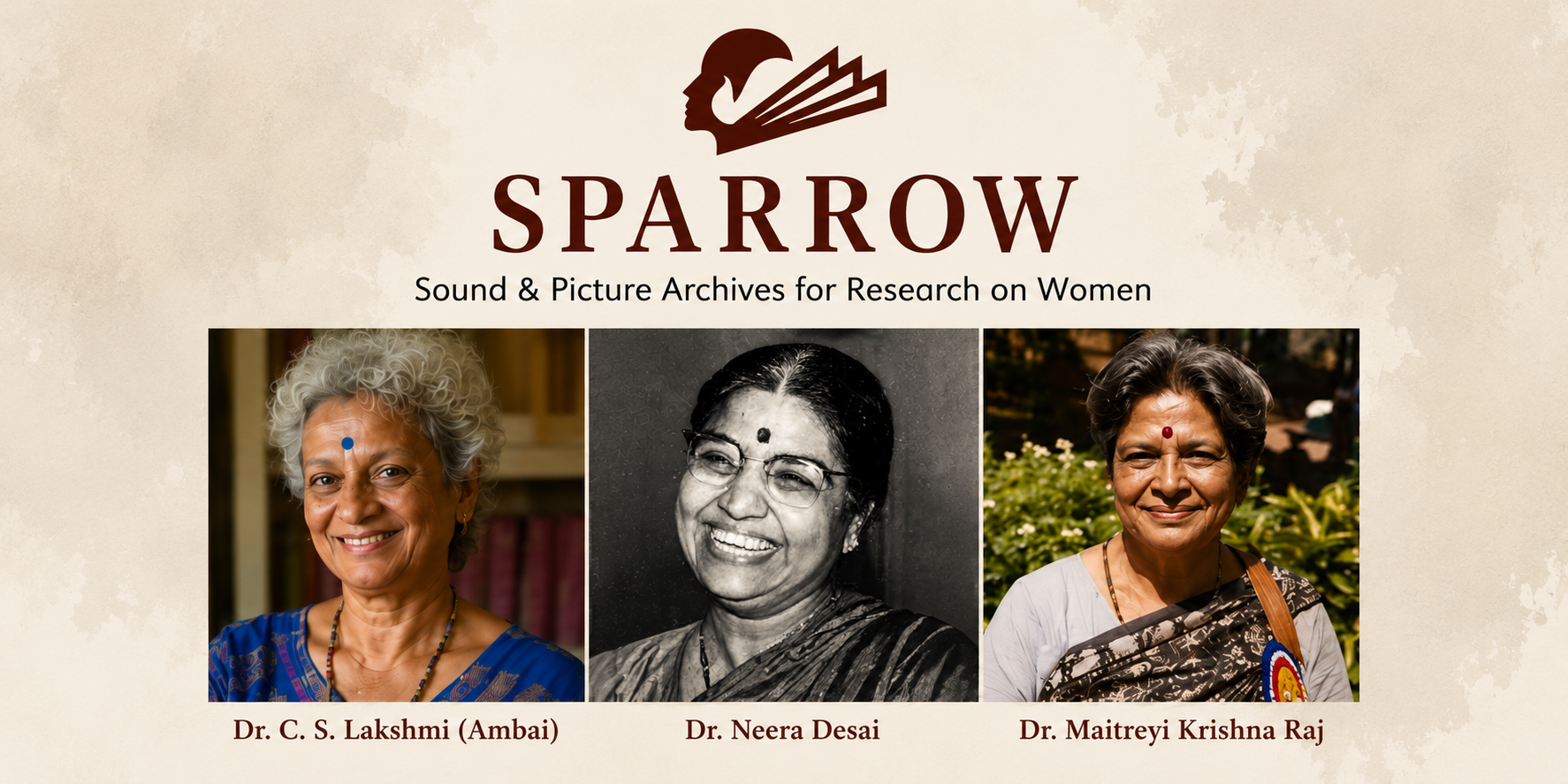
That phrase bears weight, because SPARROW was never imagined as a polite storage room. The Sound & Picture Archives for Research on Women (SPARROW) was founded in 1988 by Dr. C. S. Lakshmi, Dr. Neera Desai and Dr. Maithreyi Krishna Raj. The impulse behind it was not only to preserve documents, but to correct a deeper imbalance: the way women’s lives entered public memory late, partially, or not at all. The archives were conceived around oral history, print and visual materials, and the conviction that knowledge about women’s lives is essential to broader social change.
Conventional archives could hold state records. They could hold the visible machinery of public life. But women’s experiences did not always arrive as a file. Sometimes they arrived as recollection. Sometimes as hesitation. Sometimes, as a sentence spoken after the tape recorder was nearly switched off. In reflections on feminist archiving, Dr. Lakshmi has repeatedly underlined that SPARROW’s work was shaped by the understanding that women’s histories are not contained only in written texts, but also in oral and visual forms, and that these are not lesser sources. They are history too.
To say this now may sound self-evident. It was not self-evident then. One of the recurring tensions in accounts of SPARROW’s early years is the narrow way in which “development” was understood. Developmental work for women was expected to be restricted to welfare, livelihood, training, and rehabilitation. Archiving did not fit that picture. It seemed too intangible, too intellectual, too secondary to immediate needs.
But that misunderstanding misses something profound: if a community is denied memory, it is also denied continuity. If women’s lives are not documented, they are endlessly made to begin from scratch. Each generation has to prove itself all over again. Each struggle seems isolated. Each act of resistance looks accidental. Documentation, then, is not a luxury after the real work is done. It is part of the real work.
The Birth of SPARROW
SPARROW began with a question that had been troubling feminist scholars in India through the 1980s: if women had been thinking, writing, organising, resisting and creating for generations, why was so little of their lives documented?
In 1988, three women decided to address that absence. Dr. C. S. Lakshmi, a renowned Tamil writer who publishes fiction as Ambai, joined hands with two pioneering feminist scholars, Dr. Neera Desai and Dr. Maithreyi Krishna Raj, to establish SPARROW: the Sound and Picture Archives for Research on Women. The idea was simple yet radical: to build archives dedicated to documenting Indian women’s contributions to shaping the lives, culture, politics and society of India.
.jpg)
At the time, archives in India largely preserved state records, official correspondence, and the papers of prominent public figures. The everyday histories of women, including their letters, oral narratives, photographs, manuscripts, performances, struggles and movements, rarely entered institutional memory. In her own words, Dr. Lakshmi described the aim of SPARROW as archiving “the politics of everyday life faced by women.”
SPARROW started as a small trust in Mumbai in 1988, without a permanent office or infrastructure. Materials were gathered slowly, often through personal networks and field visits. Interviews were recorded whenever the opportunity arose. Documents were collected, catalogued, and preserved in whatever spaces were available at the time. The archives moved through several temporary locations during their early years.
What allowed SPARROW to slowly take shape was a combination of intellectual collaborations and modest but crucial sources of support. One of the earliest and most important forms of institutional backing came in the form of a ten-year grant from the Dutch development organisation HIVOS, which gave SPARROW the wings to expand the documentation work. Even before stable funding arrived, the founders found creative ways to sustain the work. In 1992, an art exhibition organised as a fundraiser helped the organisation move into a small room in Juhu.
In parallel with this archival work, Dr. Lakshmi herself was engaged in research projects that strengthened the intellectual foundations of the archives. Her work on the Illustrated Social History of Women in Tamil Nadu, supported by the Ford Foundation, and later the Homi J. Bhabha Fellowship project “An Idiom of Silence”, produced oral history and visual documentation of women musicians and dancers. These studies later appeared in the form of books, The Singer and the Song and Mirrors and Gestures. These were early examples of the kind of documentation that SPARROW would continue to build.
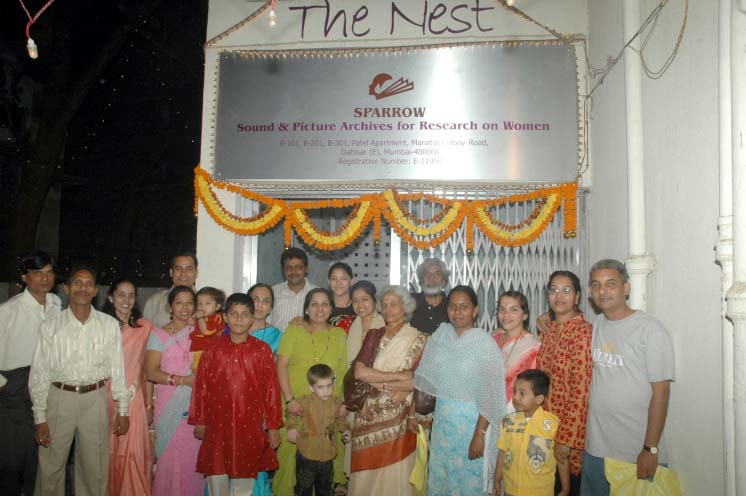
Over the next decade, SPARROW continued to expand its work by conducting oral history interviews, organising exhibitions, publishing research, and producing documentary films about women who had shaped cultural and social life in India. Eventually, after years of moving through temporary spaces, the organisation acquired its own building in Dahisar, Mumbai, in 2008, where the archives today occupy multiple floors, housing the library, archives and offices.
Looking back, the beginnings of SPARROW seem almost improbably modest for what it would become: India’s most significant sound and picture archives devoted to women’s history.
To be continued...
--
Acknowledgement:
The author acknowledges the assistance of archival material shared by SPARROW, as well as publicly available interviews, publications, and research material on the work of SPARROW and Dr. C. S. Lakshmi (Ambai).
