SPARROW – A Space for Every Woman’s Voice : Part 2
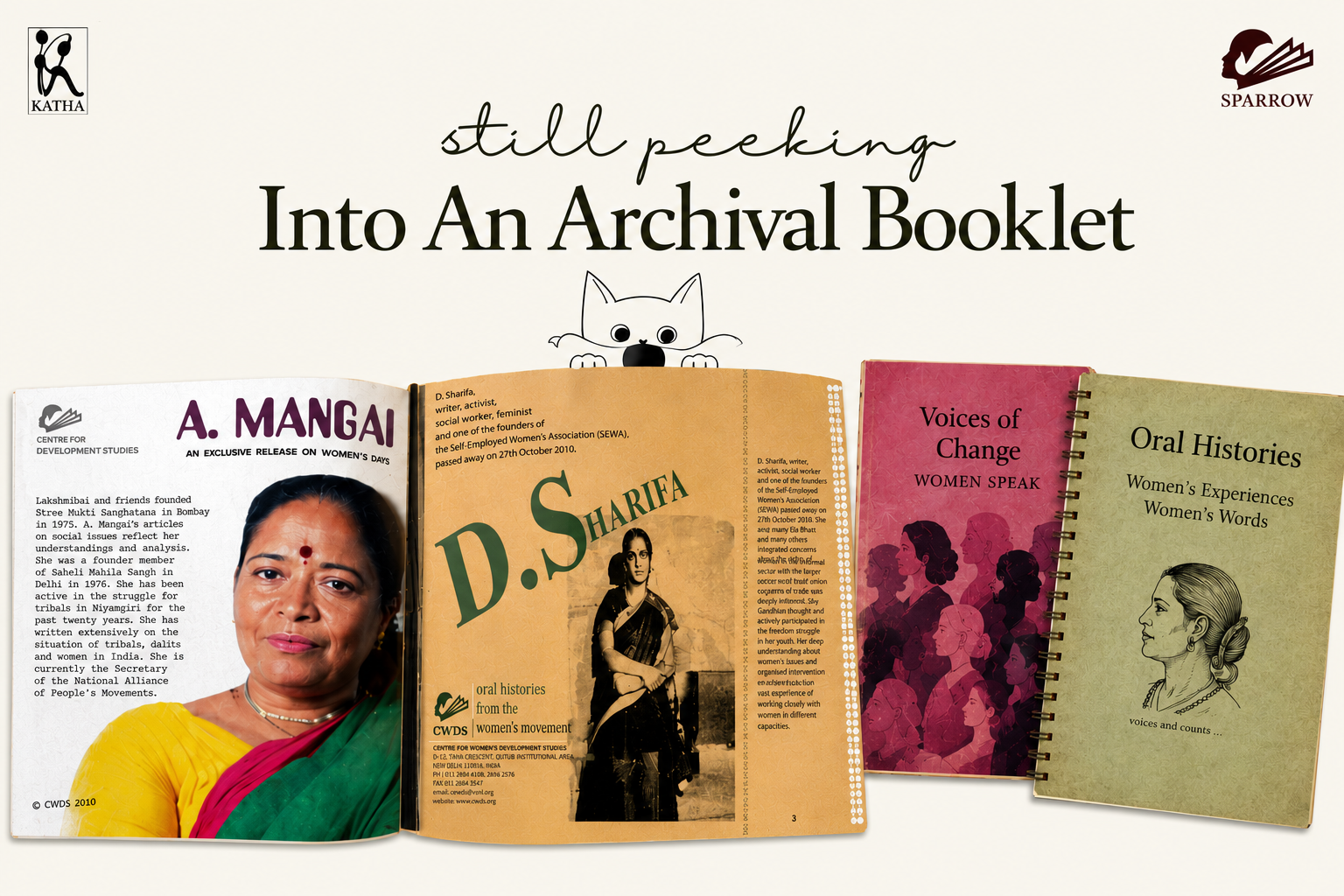
In the first part, Niketa Mulay brought us to the threshold of SPARROW and helped us understand why such a space needed to exist; here, she takes us deeper into what it has become, moving through the many ways in which women’s histories are held, expressed and kept alive. As her narrative unfolds, the archive begins to feel less like a place and more like a living practice shaped by voices, relationships and time, and just as we begin to settle into this understanding, she gently leads us toward the people behind it, inviting us to continue with her into what comes next.
What SPARROW Collects and Why it Matters
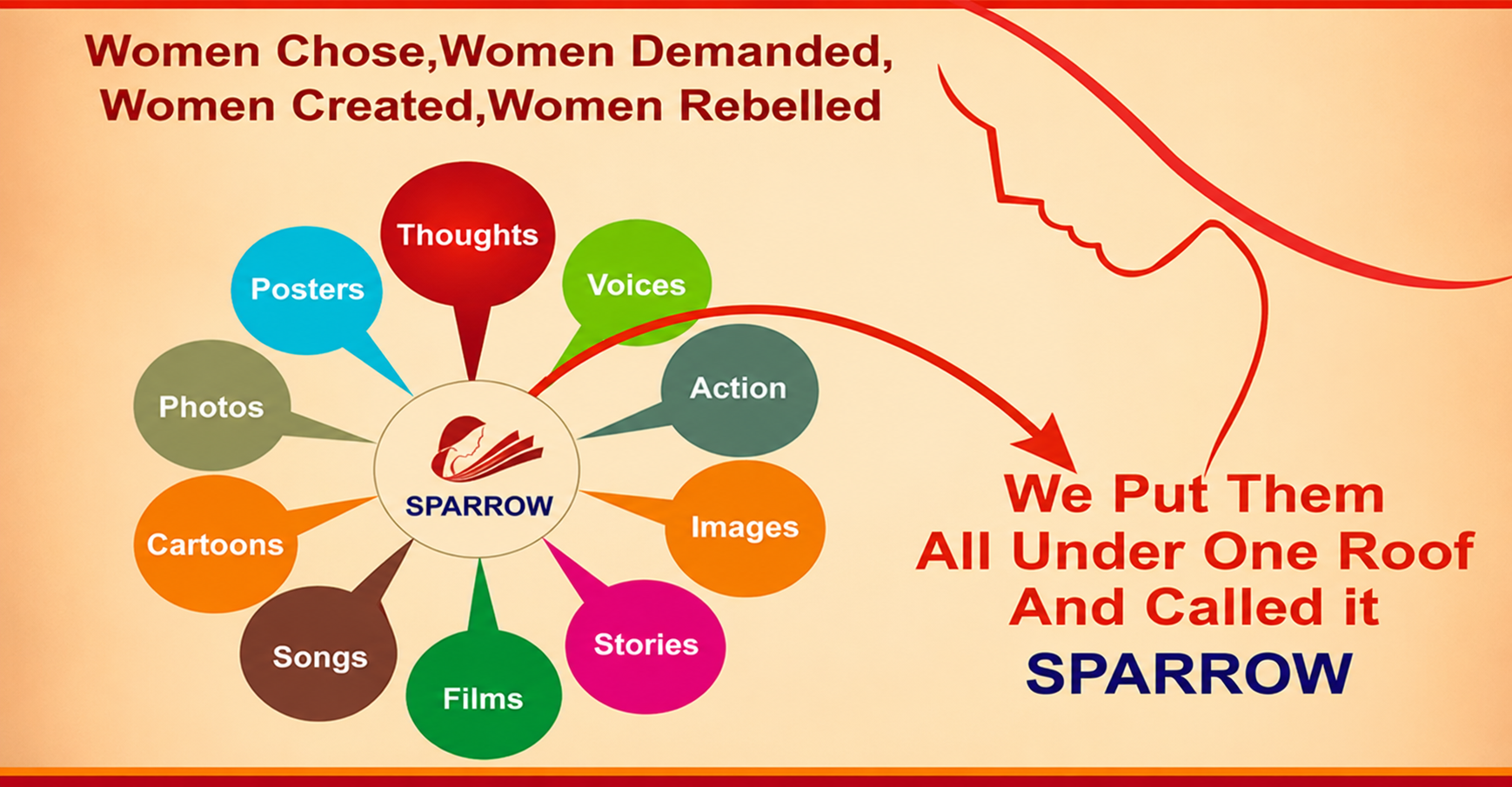
It is tempting to call SPARROW a documentation organisation and leave it at that. But the word ‘archives’ feels too still for the life inside them. What SPARROW has built over the years is not a single collection arranged neatly by category. It is a many-roomed practice of listening, recording, preserving, interpreting and returning women’s lives to public memory. Its work moves across oral history, video, photography, print culture, translation, exhibitions, films and publications. The archives do not gather material in a single form because women’s histories do not survive in one form alone. They arrive as speech, as image, as song, as pamphlet, as poster, as clipping, as testimony, as unfinished paper, or as gesture.
SPARROW’s major projects include the Oral History Recording Programme, Digital Video Recording Projects, Photography Project, Media Watch Project, Multilingual Collection Project, and NGO Documentation. Later initiatives also include Project Maya Kamath, Women Scientists and Global Feminisms.
The Oral History Recording Programme lies at the heart of this work. It is, in many ways, the spine of SPARROW’s imagination. It ranges widely: freedom movements, Left and other progressive movements, feminist movement, the Ambedkar movement and Dalit women’s experiences, environment movement, science studies, tribal life and struggles, communalism and human rights, traditional systems of medicine, artists, writers, educationists and policymakers.
What is striking is not merely the breadth of the list, but its refusal to separate political history from lived history. A freedom fighter like Gowramma, a socialist leader like Mrinal Gore, a Naxalite activist like K. Ajitha, a healer like Parvathiamma, a midwife like Pammu Hengsu, a performer like Pramila, a writer like Bani Basu, and a public figure like Avabai Wadia all belong within the same archival collective. The result is not a hierarchy of important women, but a field of women’s experience in which activism, labour, art, care work and thought are illuminated. This is where SPARROW’s method becomes especially clear. It does not treat oral history as supplementary to “real” documents. It treats speech itself as a historical source. That matters in a country where many women did not leave behind formal papers or were never encouraged to do so. A recorded conversation can preserve far more than information: it carries hesitation, humour, anger, irony, memory’s gaps, the texture of a life told aloud.
.jpeg)
SPARROW’s collaboration with the Global Feminisms Project at the University of Michigan shows the same seriousness of method. Between 2003 and 2005, Dr. Lakshmi and her colleagues filmed ten interviews in India for the project. The project was consciously designed to connect personal histories with broader feminist issues around violence, health, the environment, law, community development, minority identity, caste, region, and the politics of expression.
SPARROW’s Digital Video Recording Projects extend the archives into moving image, documenting lives that are inseparable from performance, craft, voice and physical presence. SPARROW’s list reads like an alternative cultural history: Pramila (Esther Victoria Abraham), the Jewish actress and first Miss India; Kanaka Murthy, a traditional sculptor; Damayanti Joshi, the dancer; Sushama Deshpande, theatre artist; Maya Rao; Ritha Devi; Vithabai, the Tamasha artist; Malathamma, theatre actress; K. R. Ambika, folk drama artist; Satyarani Chaddha of Shakti Shalini; Homai Vyarawalla, the pioneering photographer to name a few. Even in the choice of subjects, one sees SPARROW’s habit of widening the frame by including not just the national figure but also the performer, the organiser, the artist working within living traditions, the woman whose life would otherwise remain scattered across memory.
The archives’ Media Watch Project reveals another side of intelligence. SPARROW not only preserves women’s histories but also examines the visual and narrative arcs through which women are misrepresented. The project brings together print advertisements, cartoons and jokes that objectify women or reduce them to coded images of desirability and consumption. SPARROW’s description is unusually blunt and refreshing for it.
The same project also catalogues documentaries and feature films by women and on women. One example is Unlimited Girls, directed by Paromita Vohra, a film that explores feminism through conversations, myths and generational debate. Another is Preeti, Prema, Pranaya…, the Kannada film directed by Kavita Lankesh, about late-life love, shame and family control. This juxtaposition is important. SPARROW is not interested only in condemning representation; it is also interested in tracing counter-representations through films in which women think, desire, age and argue in their own terms.
The Multilingual Collection Project may be the most quietly radical of all, because it resists an English-centred understanding of feminist knowledge. SPARROW organises this project across three broad registers: The Word, The Image, and The Sound. Under ‘The Word’, it brings together books, journals, pamphlets, brochures, articles and newspaper clippings in many Indian languages, especially in areas of history and culture, which matter to women and in which women are participants. The project notes, very pointedly, that autobiographies and biographies of women are rare, that even important women often left behind life-writing only in notes, letters or family-held papers. Under ‘The Sound’, it includes songs of women’s movements and struggles, folk music, film music, classical and semi-classical forms, and radio programmes. The archives’ current public holdings give some sense of scale: 21,005 photographs, 7,600 books in 12 languages, 6,295 journal articles in 8 languages, 724 oral history recordings, 40,070 newspaper clippings in 8 languages, 1,775 posters, 301 private papers, 934 music audio cassettes/CDs, 1,288 documentary films, 5,124 print visuals, 2,421 brochures in 9 languages, 3,817 cartoons, 7,805 advertisements. and 8,000 cartoons by Maya Kamath. These are not just numbers. They tell you what kind of labour has gone into refusing the disappearance of women’s voices across languages and forms.
.jpeg)
The Photography Project’s impact can be seen in the archives’ visual holdings and in accounts of its evolution. In an interview, Dr. Lakshmi described how her research into women writers led her to photographs and family albums, where recurring visual patterns revealed the social scripting of women’s lives—the graduation photograph, the bridal portrait, the poses prepared for family and marriage. That interest widened into larger visual archives.
Some SPARROW projects work by documenting a single body of work with unusual care. Project Maya Kamath is one such example. Kamath, the Bangalore-based painter and cartoonist, is described on SPARROW’s site as witty, thought-provoking and gender-sensitive. SPARROW makes an explicit archival argument here: documenting the work of a woman cartoonist matters because women taking to cartoons is rare, and because cultural history celebrates male cartoonists far more readily. Kamath’s family entrusted the entire body of her work to SPARROW. In January 2005, the archives held an exhibition of her cartoons in collaboration with Cymroza Art Gallery. There is something deeply characteristic in this gesture. SPARROW not only collects the already acknowledged, but it also intervenes in recognition itself.
The same can be said of the Women Scientists project. Here, the archives moved into another kind of public absence. It was the near invisibility of Indian women scientists in school memory. The Department of Science and Technology, Government of India, through its Science and Society programme and Task Force for Women in Science, entrusted SPARROW with the task of designing a book for young readers eager to know who their foremothers in science are in India. The problem was profound. From the early twentieth century onward, there have been extraordinary women scientists in India, yet they are still largely absent from textbooks, where girls too often grow up knowing only Madame Curie as the exemplary woman in science. This is classic SPARROW territory; not simply compiling data but altering the conditions of cultural memory.
Another strand of SPARROW’s work emerges through initiatives such as Coral Jasmine, a project devoted to documenting women whose knowledge exists outside formal institutions. The series focuses particularly on women practitioners of traditional healing systems and indigenous knowledge practices whose contributions often remain invisible within conventional histories.
Taken together, these projects show that SPARROW has never confined itself to a single archival logic. It does not collect only documents, only testimonies, only visual material, only books, or only films. It works instead through a larger feminist intuition: that women’s lives are made legible only when one is willing to follow them across forms. That is why SPARROW matters. It does not simply store women’s history. It keeps widening the very idea of what counts as history.
The Living Archives
From its earliest years, the organisation understood that preserving women’s histories was not enough. Those histories also needed to circulate through speech, debates, reading, arguments and translations and thus be remembered in public memory. And so, SPARROW grew into something more animated: a space where documentation and dialogue move constantly in and out of one another.
One of the ways this happens is through writers’ gatherings and camps, events that bring together women writing in different Indian languages, often from vastly different social and regional contexts. In these gatherings, the emphasis is rarely on academic papers or literary theory. Instead, writers read their own work—poems, stories, fragments of memory—often first in their own language and then in translation. The atmosphere can be informal, even intimate.
The archives have also become a place where artists, scholars and activists encounter each other’s work. Exhibitions have been one of SPARROW’s most effective tools in this regard. Early in its life, exhibitions helped the organisation introduce the idea of a women’s archives to audiences who had never considered such a possibility. Posters, photographs, manuscripts, personal letters and oral histories were displayed not merely as artefacts but as fragments of larger narratives about women’s labour, creativity and political participation.
Films have played a similar role. The documentaries produced by SPARROW are not simply biographical portraits but attempts to capture lives that cannot be understood through written record alone. A dancer’s body of knowledge, a folk performer’s repertoire, a photographer’s visual memory, or a theatre artist’s improvisation are forms of cultural practice that live in movement and voice. Recording them on film allows the archives to preserve dimensions of women’s work that would otherwise be forgotten.
The archives’ own publications extend this dialogue further. Books emerging from SPARROW’s research transform archival material into narratives accessible to readers outside academic circles. In this way, the archives become not only a collector of history but also a storyteller. SPARROW continues to create spaces for dialogue and recognition through its newsletter, workshops and literary initiatives. The SPARROW Newsletter documents research, archival discoveries, profiles of women across fields, and reflections emerging from the organisation’s work. Workshops conducted in SPARROW premises, schools, colleges and cultural forums encourage discussions on women’s histories, representation and social change. The organisation also instituted the SPARROW Literary Award to recognise significant contributions by women writers, reinforcing the archives’ long-standing commitment to literature across languages.
.jpeg)
What emerges from all this activity is an understanding of SPARROW as a living institution. Its shelves are not endpoints but starting points. A recorded interview may later become a film. A research project may grow into a book. A writer’s camp may inspire new translations. A photograph rescued from a family album may become part of an exhibition that alters how viewers think about the past.
Archives That Listen
Standing inside SPARROW, one begins to realise that the archives have grown not simply through collecting material but through the discipline of listening. Over the decades, this listening has created something remarkable. What began in 1988 as a modest initiative among feminist scholars has grown into one of India’s most significant repositories of women’s history and cultural memory. Yet the spirit of the place still feels intimate rather than monumental.
It is difficult to stand among these shelves without wondering how such a space came into being at all. Archives usually grow around the power of governments, institutions, and universities. SPARROW grew around a different kind of energy: the belief that women’s lives, in all their complexity, deserve to be remembered.
At the centre of that belief stands a woman who has spent much of her life listening to other women speak. Her name is Dr. C. S. Lakshmi. But readers of literature know her by another name: Ambai. Her story is inseparable from the story of these archives. And it begins long before SPARROW itself.
-- Acknowledgement:
The author acknowledges the assistance of archival material shared by SPARROW, as well as publicly available interviews, publications, and research material on the work of SPARROW and Dr. C. S. Lakshmi (Ambai).
